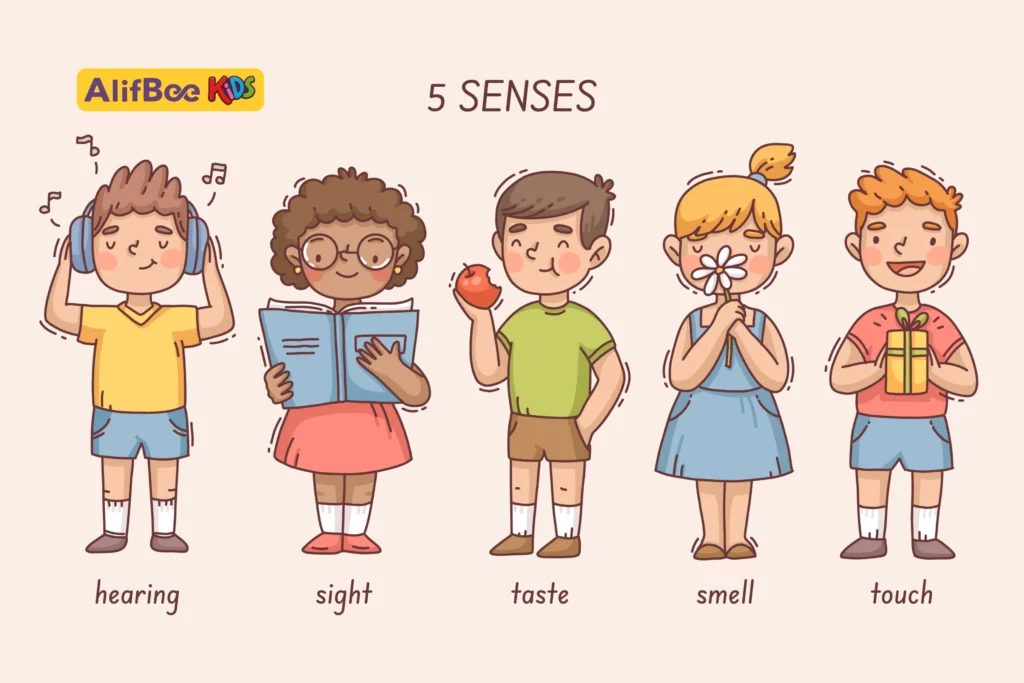
At a Glance: The five senses in Arabic are al-baṣar (Sight), as-samʿ (Hearing), ash-shamm (Smell), al-lams (Touch), at-tadhawwuq (Taste). Teach one or two senses at a time if five new terms feel like too much. Let your child handle safe objects while you repeat the Arabic word. Use short first-person phrases so the vocabulary becomes part of speech.
A jingling set of keys, a soft towel, and a slice of lemon can become a short Arabic lesson. At ages three and four, children naturally explore the world around them through their senses. They listen to sounds, feel different textures, smell new scents, and taste different foods. Use these everyday moments to introduce simple Arabic words for what they see, hear, smell, feel, and taste.
This activity teaches the five senses in Arabic for about ten minutes and uses items you probably have at home. Your child does not need to recognize Arabic letters yet. Begin with listening, pointing, and repeating, then return to the same words during meals, bath time, or a walk outside.
What Are the Five Senses in Arabic?
Start with the names of the senses. Say each pronunciation slowly, then connect it to the body part your child uses.
| Meaning | Pronunciation | Arabic |
|---|---|---|
|
sight |
al-baṣar
|
الْبَصَرِ |
|
hearing |
as-samʿ
|
السَّمْعِ |
|
smell |
ash-shamm
|
الشَّمِّ |
|
touch |
al-lams
|
اللَّمْسِ |
|
taste |
at-tadhawwuq
|
التَّذوُّقِ |
Arabic Body Parts and Action Words for the Five Senses
| Meaning | Pronunciation | Arabic |
|---|---|---|
|
eye |
ʿayn |
عَيْن |
|
ear |
udhun |
أُذُن |
|
nose |
anf |
أَنْف |
|
hand |
yad |
يَد |
|
tongue |
lisān |
لِسَان |
|
I see
|
arā |
أَرَى |
|
I hear
|
asmaʿ |
أَسْمَع |
|
I smell
|
ashumm |
أَشُم |
|
I touch
|
almis |
أَلْمِس |
|
I taste
|
atadhawwaq
|
أَتَذَوَّق |
How to Teach the Five Senses in Arabic: Sensory Hunt
Choose four or five child-safe objects with clear differences: a red ball, a bell or sealed container filled with rice, a piece of cotton, a fragrant orange peel, and a familiar food. Keep the objects out of sight until the activity begins.
- Show one object. Name the sense and the body part in Arabic, then let your child point to the correct part of the body.
- Invite your child to explore the object. Repeat the action word, such as arā for “I see” or almisu for “I touch.”
- Offer two choices: “Is it khāshin (rough) or nāʿim (smooth)?” Accept pointing before expecting a spoken answer.
- Finish by mixing the objects and asking your child to choose one for sight, sound, smell, touch, or taste.
Easy Arabic Five-Senses Sentences for Kids
| Meaning | Pronunciation | Arabic |
|---|---|---|
|
I see a red ball.
|
arā kuratan ḥamrāʾ
|
أَرَى كُرَةً حَمْرَاء.
|
|
I hear a sound.
|
asmaʿu ṣawtan
|
أَسْمَعُ صَوْتًا.
|
|
I smell the lemon.
|
ashummu rāʾiḥata al-laymūn
|
أَشُمُّ رَائِحَةَ اللَّيْمُون.
|
|
This is smooth.
|
hādhā nāʿim
|
هَذَا نَاعِم.
|
|
The lemon is sour.
|
al-laymūnu ḥāmiḍ
|
اللَّيْمُونُ حَامِض.
|
Keep the Activity Safe and Light
Supervise every tasting activity. Use foods your child has eaten safely before, check for allergies, and keep unknown plants, medicines, cleaning products, hot items, and small objects that could pose a choking hazard away from the table. If a child doesn’t want to smell or taste an item, they can simply watch.
The National Association for the Education of Young Children recommends child-friendly definitions, descriptive words, and open questions during science exploration. Follow your child’s interest: if the jingling keys hold their attention the longest, spend another minute listening instead of rushing to the next object.
3 More Five Senses Activities in Arabic for Kids
Once your child knows a few of the basic words, try them in different kinds of play. You do not need to practice all five senses in every activity. Choose one or two Arabic words, repeat them naturally, and bring them back another day.
1. Play a Mystery Touch Bag
Place a few familiar objects inside a cloth bag or pillowcase. Choose things with noticeably different textures, such as a soft toy, a wooden spoon, a sponge, or a smooth ball.
Ask your child to reach inside without looking and feel one object. Repeat almis (“I touch”) and ask simple questions such as:
- Is it nāʿim (smooth) or khāshin (rough)?
- Is it soft or hard?
- What do you think it is?
Let your child guess before pulling the object out. Then repeat the Arabic word for touch, al-lams, together.
2. Guess the Sound
Collect three or four objects that make recognizable sounds. You might use keys, paper to crumple, a spoon tapping a cup, or a sealed container with rice inside.
Ask your child to close their eyes while you make one sound. Say asmaʿ (“I hear”), then let them guess what made the noise.
After a few rounds, switch roles. Your child makes the sound while you guess. This gives them another reason to hear and repeat as-samʿ, the Arabic word for hearing.
3. Be a Smell and Taste Detective
Choose two or three familiar foods with clear smells or tastes, such as banana, orange, mint, or lemon. Only use foods your child already eats safely.
Let your child smell an item first and say ashumm (“I smell”). Then ask them to describe or identify it. If the food is safe to taste, let them take a small bite and repeat atadhawwaq (“I taste”).
You can make the game easier by offering two choices: “Is it lemon or orange?” As the words become familiar, let your child answer without clues.
Continue Learning with AlifBee Kids
A sensory hunt introduces a small group of useful words. Repeated listening and play help those words stay familiar. Continue with AlifBee Kids, where children aged 2-8 can meet Arabic through immersive games, videos, and songs.
You can also explore our complete body-parts guide when you want to add words such as head, face, foot, and finger.
FAQs
What are the five senses called in Arabic?
The five senses are sight (al-baṣar), hearing (as-samʿ), smell (ash-shamm), touch (al-lams), and taste (at-tadhawwuq). Young children do not need to memorize all five at once. Introduce one or two during everyday play and return to them often.
How can I teach the five senses in Arabic to a preschooler?
Connect each Arabic word to something your child can see, hear, smell, touch, or taste. Simple activities such as a sensory hunt, mystery bag, or sound-guessing game make the vocabulary easier to understand because the child experiences the meaning while hearing the word.
Which five senses words should my child learn first in Arabic?
Start with the sense words and the related action verbs, such as arā (“I see”), asmaʿ (“I hear”), and almis (“I touch”). You can then add body-part words such as ʿayn (eye), udhun (ear), and anf (nose).
Can children learn the five senses in Arabic if they cannot read Arabic yet?
Yes. Kids can begin through listening, pointing, movement, and play. They can hear the Arabic word while using the corresponding sense, without needing to recognize or read the written word first.