At a Glance: Learn ten everyday shape words with the AlifBee Kids worksheet. Find matching shapes around your home. Finish with a quick check to choose what to practice next.
A clock face, a book cover, a triangle cut from paper: your first Arabic shape lesson can start with what is already on the table.
Download the Printable Shapes in Arabic Worksheet
Print the AlifBee Kids worksheet and use it with the words and activities below.
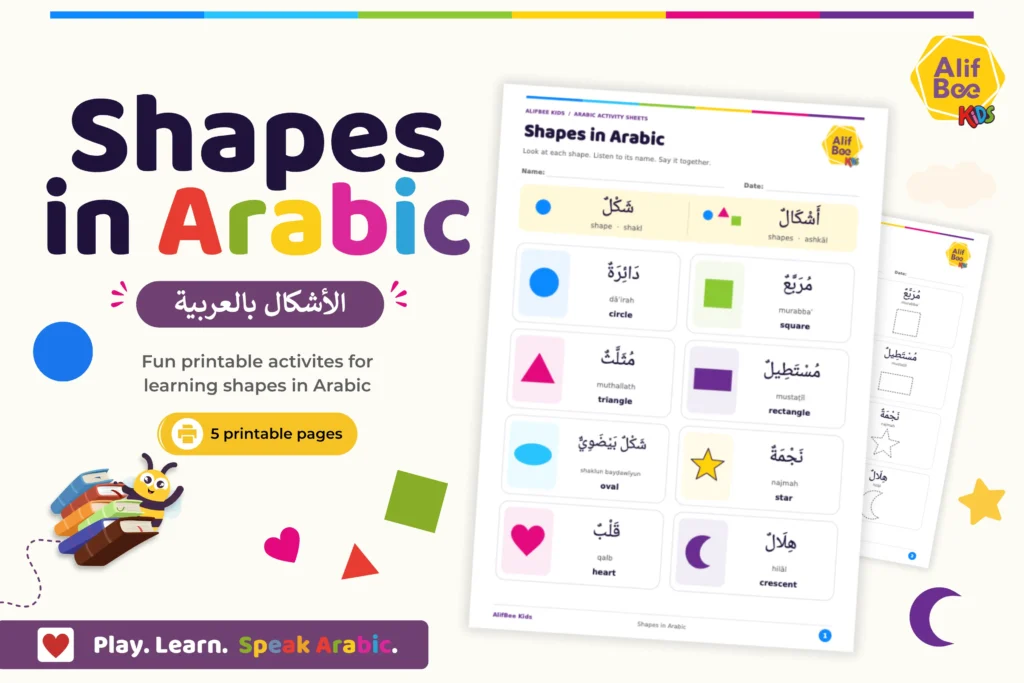
Shapes in Arabic
Start with dāʾirah, murabbaʿ, muthallath, and mustaṭīl. Save the other words for later.
| Meaning | Pronunciation | Arabic |
|---|---|---|
|
shape |
shakl |
شَكْلٌ |
|
shapes |
ashkāl |
أَشْكَالٌ |
|
circle |
dāʾirah |
دَائِرَةٌ |
|
square |
murabbaʿ |
مُرَبَّعٌ |
|
triangle |
muthallath |
مُثَلَّثٌ |
|
rectangle |
mustaṭīl |
مُسْتَطِيلٌ |
|
oval |
shaklun bayḍawīyun
|
شَكْلٌ بَيْضَوِيٌّ
|
|
star |
najmah |
نَجْمَةٌ |
|
heart |
qalb |
قَلْبٌ |
|
crescent |
hilāl |
هِلَالٌ |
Pronunciation follows a pause at the end of each word or phrase. The Arabic keeps its vowel marks and case endings. Long vowels are written ā, ī, and ū; ʾ marks a glottal stop, and ʿ represents the Arabic sound ʿayn.
Try a 10-Minute Arabic Shape Hunt
Set out the worksheet, a pencil, and a few safe objects or paper shapes. Allow about ten minutes, but stop earlier if your child has had enough.
Choose and point. Pick two shapes to begin. Say dāʾirah as you point to a circle, then name the other shape. Ask, “Where is the dāʾirah?” Your child can answer by pointing; they do not need to repeat the word yet.
Find a match. Look for a round clock face, a square coaster, or a rectangular book cover. Ask your child to match one to a shape you have named. Use a paper triangle if there is no suitable example nearby. Look at the flat outline or surface: a ball is a sphere, not a circle.
Swap jobs. Let your child choose a shape and say its Arabic name while you look for it. If they need a prompt, offer two choices: “Dāʾirah or murabbaʿ?” Take another turn with the same word before adding a new one.
Make a picture. On separate paper, draw a house with one square, one triangle, and two rectangles. Ask your child to find and name each shape. Then let them change the picture: could a circle become a window?
These activities also include the identifying, comparing, and composing of shapes described in Head Start’s preschool math guidance.
Arabic Prompts to Use During the Game
Choose one question and one reply. Use hādhihi with dāʾirah and hādhā with murabbaʿ, as shown below.
| Meaning | Pronunciation | Arabic |
|---|---|---|
|
This is a circle.
|
hādhihi dāʾira
|
هٰذِهِ دَائِرَةٌ.
|
|
This is a square.
|
hādhā murabbaʿ
|
هٰذَا مُرَبَّعٌ.
|
|
I see a triangle.
|
arā muthallath
|
أَرَى مُثَلَّثًا.
|
|
Where is the rectangle?
|
ayna al-mustaṭīl?
|
أَيْنَ الْمُسْتَطِيلُ؟
|
|
Let’s look for a circle.
|
hayyā nabḥathu ʿan dāʾirat
|
هَيَّا نَبْحَثُ عَنْ دَائِرَةٍ.
|
What Should Your Child Practice Next?
At the end, try two turns without showing the Arabic labels. First, say a shape word and ask your child to point to the matching object or drawing. Then point silently and ask them to name it. Note which words needed help.
- Needs help finding the shape: Return to two choices. Point and say each word together, then ask again.
- Finds it but does not name it yet: Keep the same words. Offer a choice of two Arabic names or model the answer and invite another turn.
- Finds and names the shapes: Try a new example, a different size, or a short sentence before adding another word.
This is an informal practice check, not an assessment of your child’s development or overall Arabic level. Keep a note of the words you used and try them again another day.
Adapt the Activity for Ages 3–8
Choose the version that fits your child’s current Arabic and pencil skills. These age ranges are starting suggestions, not milestones.
- Ages 3–4: Offer two large shapes and let your child point or bring you a matching object. Skip writing if they are not ready for it.
- Ages 5–6: Try three or four shapes. Invite your child to draw a matching outline on separate paper and say its name.
- Ages 7–8: Let your child lead the hunt, label a drawing, or use a full sentence. An older beginner can still start with pointing.
Keep the Worksheet for Another Round
Next time, change the objects. A child who found a circle in the clock face can look for one in a plate viewed from above. Use the same Arabic word, then let them choose what to find next.
If your child already knows some colors, pair this activity with our colors in Arabic guide. Ask them to find a blue square or a red circle, using the guide for the matching color forms.
For another vocabulary theme, browse our first Arabic words for children. You can also explore AlifBee Kids for more Arabic practice between activities at home.