
Prophet Musa Story for Kids
Summary
The story of Prophet Musa for kids is full of courage, hope, and miracles. It is an essential story in Islamic history, offering valuable lessons for parents and teachers to teach children.
Prophet Musa (AS) was sent to the Pharoah of Egypt in times of injustices to Bani Israel (Children of Israel).
injustice
zulm
ظلم
His mother put him in a basket in the Nile River, and Allah safeguarded him and brought him into the Pharaoh’s palace. Years later, Allah chose him to be a messenger. He gave him clear signs and sent him to guide Bani Israel (children of Israel). Israel is another name for Prophet Yaqub (Jacob). Allah saved them by splitting the Red Sea.
Lesson summary:
This story teaches kids to trust Allah in hard moments, speak the truth, and stay patient. It teaches us to repent, admit mistakes, to make dua, and keep worship for the one true God. Prophet Musa (AS) shows us that courage may reside within the loving heart when youhold tight to the faith in Allah.
Who Was Prophet Musa (AS)?
Prophet Musa (AS) is one of the greatest Prophets in Islam; he is known as Moses in English. He lived in Egypt during Pharoh’s injustice. Allah sent Musa to guide Bani Israel (the Children of Israel) and to call Pharaoh to stop his injustice and worship only Allah. At that time, Pharaoh arrogantly told the people that he was their only god. Parts of this story can be found in Surah Ta-Ha.
Quick Facts About Prophet Musa (AS)
- A Prophet and messenger of Allah
- Lived in Egypt, and later traveled to Madyan (a city in northwestern Saudi Arabia)
- Guided Bani Israel (the Children of Israel)
- His brother Harun (AS) supported him
- His story appears in many parts of the Quran
The Birth of Musa and Allah’s Protection
Prophet Musa (AS) was born in Egypt at a time of Pharaoh’s injustice. Many families lived in fear because Pharaoh treated the Children of Israel very harshly and oppressed them. He even ordered that their newborn baby boys be killed.
Musa’s mother held onto one thing: trust in Allah. She cared for her baby in secret. Then Allah guided her to a brave step. She placed Musa in a basket and set it on the Nile River. Her heart was shaking, but her faith was strong.
The basket reached Pharaoh’s palace. When Pharaoh saw the child, Pharaoh’s wife, Asiya, felt compassion for him. She said to Pharaoh that the baby could be a comfort for both of them and asked him not to kill the child. She hoped they might adopt him as a son. Pharaoh agreed, and the baby was allowed to stay in the palace. But something surprising happened. Musa refused to drink milk from the wet nurses they brought from the city. One after another, he refused them all.
Allah was protecting him and guiding the story. Then Musa’s sister suggested someone who could help. They brought Musa’s own mother. And right away, Musa accepted her milk. That is how Allah returned Musa to his mother, safely and with honor, even from inside Pharaoh’s palace. This part of the story is mentioned in Surah Al-Qasas.
What This Teaches Kids
- Allah can protect you in ways you can not see.
- A mother’s dua is powerful.
- When you trust Allah, He can make a safe way where you least expect it.
Musa Grows Up in Pharaoh’s Palace
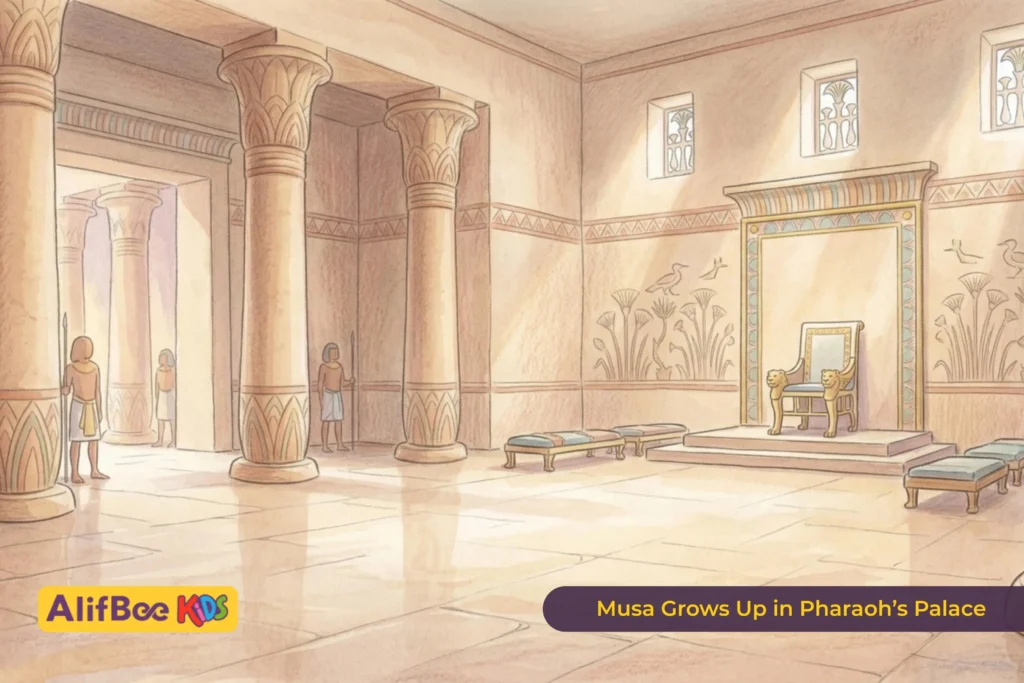
Musa grew up inside the palace, but his heart stayed with the truth. He learned what power looks like and also saw injustice.
When Musa grew older, he saw unfairness around him and wanted to help. One day, Musa tried to stop a fight. In the confusion, a man died accidentally. Musa felt regret right away. He asked Allah to forgive him and promised to do better. Musa then left Egypt because he feared unfair punishment from the ruler.
The Burning Bush – Allah Speaks to Musa

In Madyan, Musa saw two young women standing aside waiting near a well. They could not water their animals because there were many shepherds watering theirs. Musa helped them by drawing water from the well and watering their flock. Then he stepped back and made dua to Allah. (Surah Al-Qasas)
The women went home and told their father what had happened. Their father invited Musa to his home to thank him, and Musa later stayed with the family and married one of the daughters. This story is mentioned in the Qur’an, in Surah Al-Qasas.
Later, on a journey, Musa saw a fire near Mount Tur. He went closer to hear Allah speak to him, telling him that He had chosen him for a mission. Allah told Musa to return to Egypt and speak to Pharaoh to stop his injustice. He also gave Musa support through his brother Harun, so the message would be clear. This moment is described in Surah Ta-Ha.
Allah Chooses Brave Hearts: Musa felt the weight of the mission, and he asked for help. Allah gave him strength and clear signs.
The Miracles of Prophet Musa
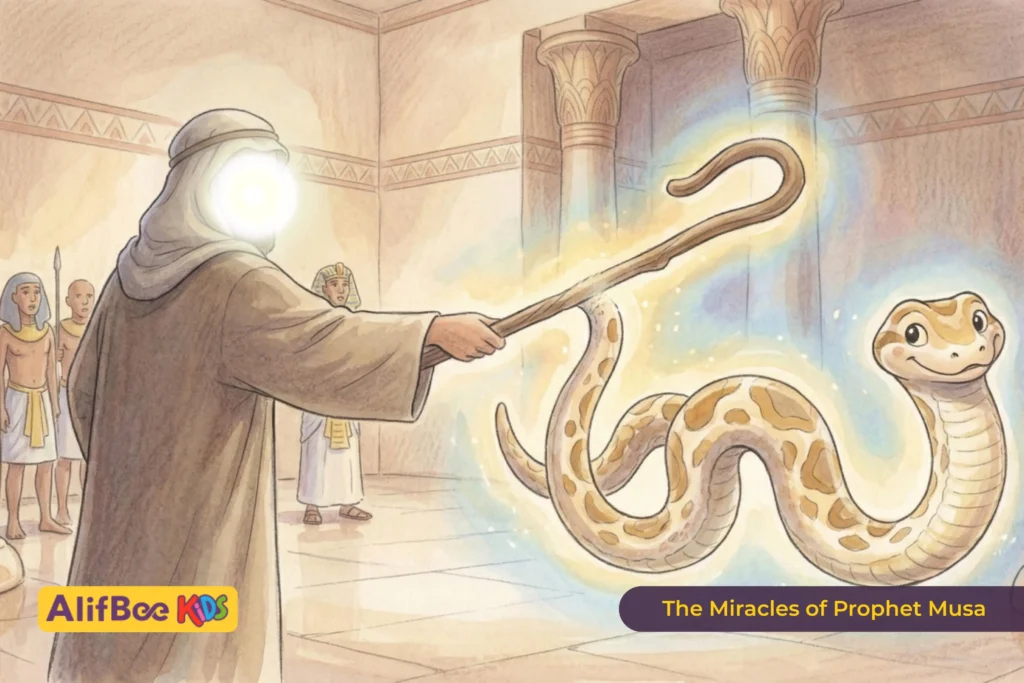
Allah gave Musa miracles and signs so people could see the truth and believe. In Surah Al-A‘raf, Allah mentions that many miracles were shown to Pharaoh and his people. These were not tricks. Each miracle was a reminder to stop their injustice and return to Allah.
The Staff That Turned into a Snake
Musa carried a staff (a stick). Allah told him to throw it down. By His permission, it turned into a snake. Pharaoh’s magicians tried their best to do the same in a contest with Musa. They threw their sticks and ropes.
Musa saw these ropes moving because of magic, and he felt afraid. But Allah supported Musa, and his snake swallowed the magicians’ ropes and sticks. When the magicians saw the truth, many believed and prostrated to Allah. They chose faith over fear, even when Pharaoh became angry. This part is mentioned in Surah Ta-Ha.
The Shining Hand
Allah gave Musa another sign. When Musa placed his hand under his arm and then brought it out, it shone with a bright light, without any harm. It was clear proof for hearts that wanted guidance.
Other signs appear in this story too, like warnings and tests to push Pharaoh to rethink his injustice, and the great rescue at the sea, which we will talk about next.
The Escape from Pharaoh and the Splitting of the Sea
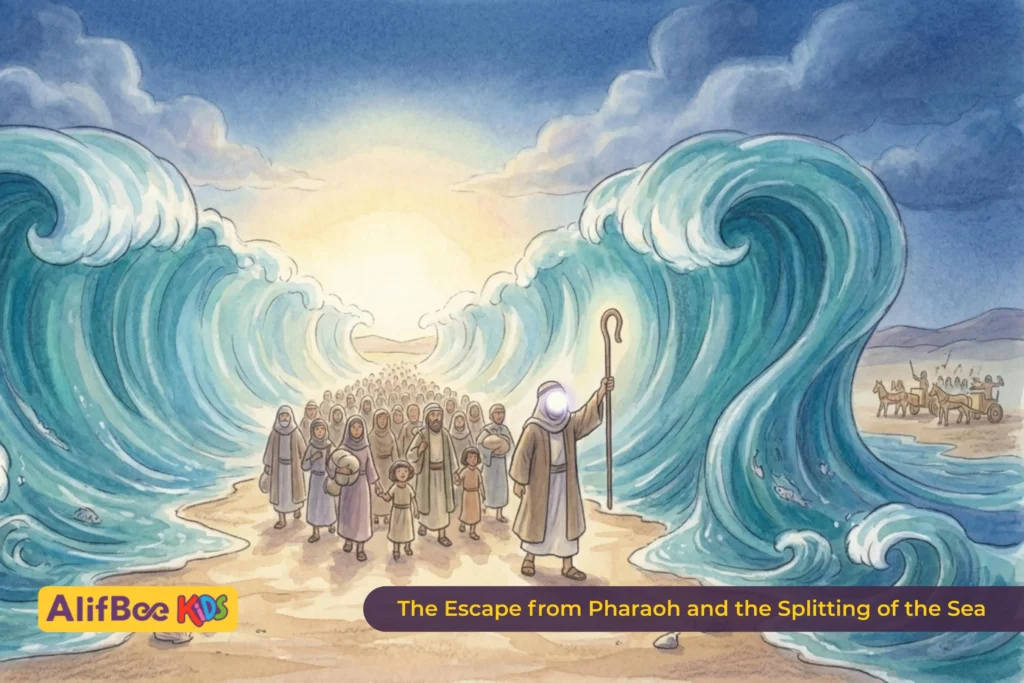
Pharaoh refused the message again and again. The persecution of the Bani Israel continued. Allah then commanded Musa to leave Egypt with the people who believed Allah’s message. They walked with hope, even though the road looked long. Pharaoh chased them, wanting to pull them back into fear.
They reached the Red Sea and felt trapped. In Surah Ash-Shu‘ara, Musa shows deep trust in Allah at this part of the story.
Allah commanded Musa to strike the sea with his staff. Musa raised it and touched the water, and by Allah’s permission, the sea parted. A safe path opened. They crossed. When the army of Pharaoh followed them, the sea closed, and Pharaoh and his army sank and died. Allah saved the believers, and Pharaoh’s defeat was complete.
5 Powerful Lessons from Prophet Musa’s Story
- Trust Allah when things look impossible.
The Red Sea looked like a wall, but Allah made a path. If you feel stuck, make dua, take one step, and keep going. - Stand up to injustice.
Pharaoh used injustice. Musa spoke with truth and respect. At school, this can mean saying “That is not fair,” for example, and helping someone who is left out. - Be patient.
Musa faced long days. He kept going. Patience is doing the right thing, again and again, even when you are tired. - Admit mistakes and return to Allah.
Musa did not pretend he was perfect. He repented and moved forward. These are important lessons for every child who wants to grow. - Lead with care.
Musa guided people, listened, and asked for help. This teaches us that strong leaders serve others and keep their hearts soft.
Why This Story Matters for Muslim Kids Today
Kids may not face Pharaoh, but they face fear, pressure, and unfair situations. The Prophet Musa’s story helps a child remember that Allah is close and that truth is worth it.
It can help with:
- Bullying: choose kindness, ask for help, stand up for what is right.
- Peer pressure: keep worshiping Allah, even if others laugh.
- School stress: make dua, study, and trust Allah with the results.
- Being fair: do not be unjust, even in small jokes.
- Feeling alone: remember that Musa walked alone for a while, yet Allah guided him.
A simple family activity (2 minutes):
Ask your child, “What would you do if you felt scared like Musa’s people at the sea?” Let them answer. Then remind them: breathe, make dua, and trust Allah.
Conclusion
The story of Prophet Musa starts with a baby in a basket floating along the river Nile and how Allah took care of him wherever he went. Musa was brought up in the palace of Pharaoh, where he came to understand what zulm~ظلم (injustice) means, and how to stand for the truth with Allah’s guidance.
Allah spoke to Musa near Mount Tur and gave him certain signs. Musa felt more confident when his brother Harun stood with him. He led Bani Israel out of Egypt, and Allah split the Red Sea so they could walk through safely. Later, Musa received guidance at Mount Sinai and taught his people to return to the one true God.
That is why the story of Musa for kids stays in the heart. It shows that courage can be quiet. It shows that dua matters. It shows that Allah can open a way when you feel stuck.
If your child loved this story, help them get even closer to Quran words in a fun, simple way. Try the AlifBee Arabic learning app for children. It uses friendly lessons and games that keep kids curious and proud of their progress. Start today and make Arabic a happy part of your child’s day.