Have you ever seen a house with big, strong pillars holding it up? Faith can feel like that, too. It needs strong support. In Islam, those supports are called the pillars of iman. The word “iman” means faith.
Faith
'iiman
إيمان
These are the fundamental beliefs that can help a Muslim know God, life, and life after this world. These beliefs are mentioned in a famous hadith. And they are:
Believing in Allah, His angels, His book, His messengers, the last day, and His decree.
What Is Iman in Islam?
Iman in Islam means faith in your heart.
It is about what you truly believe. It is not only about words. It is about faith in God, the fact that His word is true, and trying to live by that word every day.
Allah means God in Arabic, and He is one God, the Creator and Sustainer of everything.
When the children learn Iman, they learn what it means to be a Muslim.
They learn who made them. They learn why prophets were sent. They also learn that life has meaning.
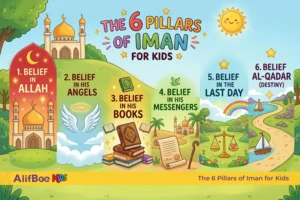
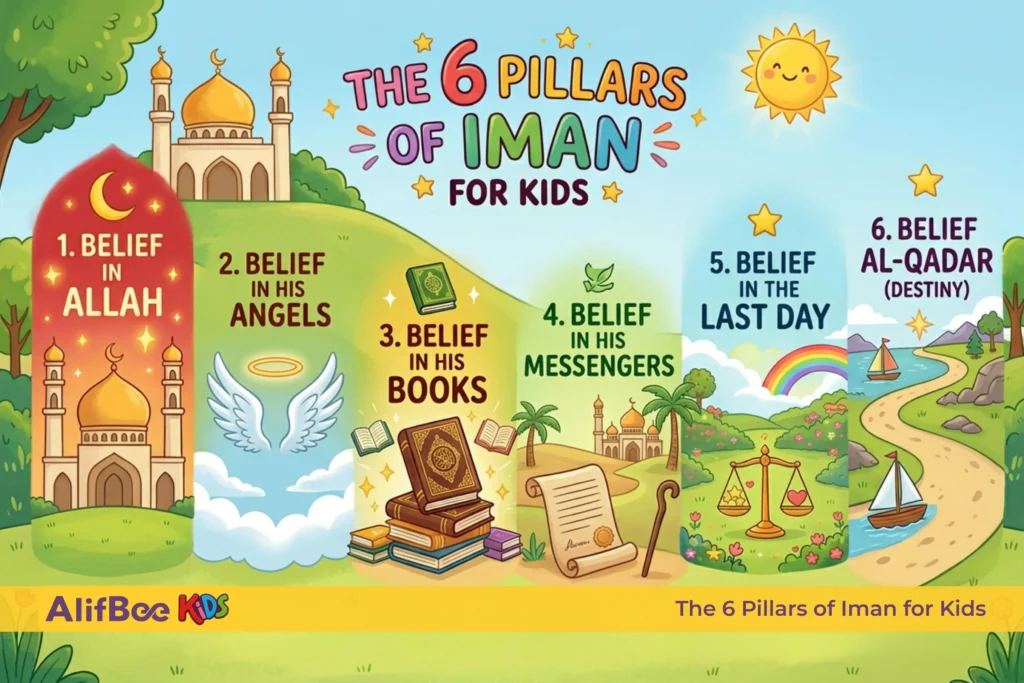
What Are the 6 Pillars of Iman?
If someone asks, what are the 6 pillars of Iman, the answer is simple.
They are:
- Belief in Allah
- Belief in angels
- Belief in Allah’s books
- Belief in Allah’s messengers
- Belief in the Last Day
- Belief in divine decree.
These articles of faith in Islam come from the famous hadith of the angel Gabriel, where the Prophet Muhammad learnt what faith means.
The Six Pillars of Iman Explained for Kids
1. Belief in Allah
The first and most important pillar of iman is belief in Allah.
Muslims believe in one God. He created the world. He knows everything. He is merciful, wise, and just. He is the One we worship, rely on, and address at all times. In Islam, Allah is the only God and Creator, and he is the Keeper and Restorer of the world.
For children, this is very comforting.
You are never alone. God sees you, listens to you, and loves you. When you are happy, He knows. When you are scared, He knows. When you do something wrong, you can ask Him for help and forgiveness.
2. Belief in Angels
Belief in angels is the second pillar of iman.
Muslims also believe in angels, beings that we cannot see. In Islam, angels live in an unseen world and carry out tasks given to them by God.
The fact that you can not see something does not mean that it does not exist. We cannot see the wind, yet we know it exists. Similarly, angels exist because God told us about them.
Angels make kids remember that God’s world is bigger than what our eyes can see.
3. Belief in Allah’s Books
The third one is faith in the books that God sent to this world.
Muslims believe that God sent guidance through holy books. Islam teaches that the Quran was revealed to the Prophet Muhammad and that earlier prophets like Moses and Jesus also received revelation.
For kids, this means God did not leave people without help in the ages before Muhammad.
He gave them the way to live, how to worship, how to treat others, and how to know what is right and wrong.
The Quran is particularly important for Muslims because it is the last book that God revealed.
4. Belief in Allah’s Messengers
The fourth pillar is faith in the messengers and the prophets.
Muslims believe that God sent many prophets to lead people. Islam teaches us that Muhammad is the final prophet in a long line, like Adam, Noah, Abraham, Moses, and Jesus.
Children often love stories, and the stories of the prophets are important for a reason.
They teach courage, patience, honesty, trust, prayer, and hope. When kids hear about Prophet Nuh staying strong, or Prophet Musa standing up to Pharaoh, they see what faith looks like in real life.
This part of Iman shows that God guided people again and again.
5. Belief in the Last Day
The fifth pillar is belief in the Last Day.
Muslims believe this world will not last forever. Islamic teaching says there will be a Last Day when people will be raised again and judged according to their deeds.
God is perfectly fair. Every good thing matters. Every wrong thing matters too. If someone is kind, honest, and patient, that goodness is never wasted. If someone hurts others, that is not ignored.
Belief in the Last Day helps children understand responsibility. It teaches them that choices matter. It helps them understand why truth, kindness, and obedience are important even when nobody else is watching.
6. Belief in Divine Decree
The sixth and final pillar of iman is faith in the divine decree.
This means that Muslims believe that God knows everything and nothing occurs without His knowledge.
Even though scholars have discussed how destiny and human responsibility work together, children can understand the main idea easily:
God is in control, and God is wise. We try our best, we make good decisions, and leave the rest to Him. This pillar brings peace to a child’s heart, helping them feel safe and cared for.
Why the Pillars of Iman Matter for Kids
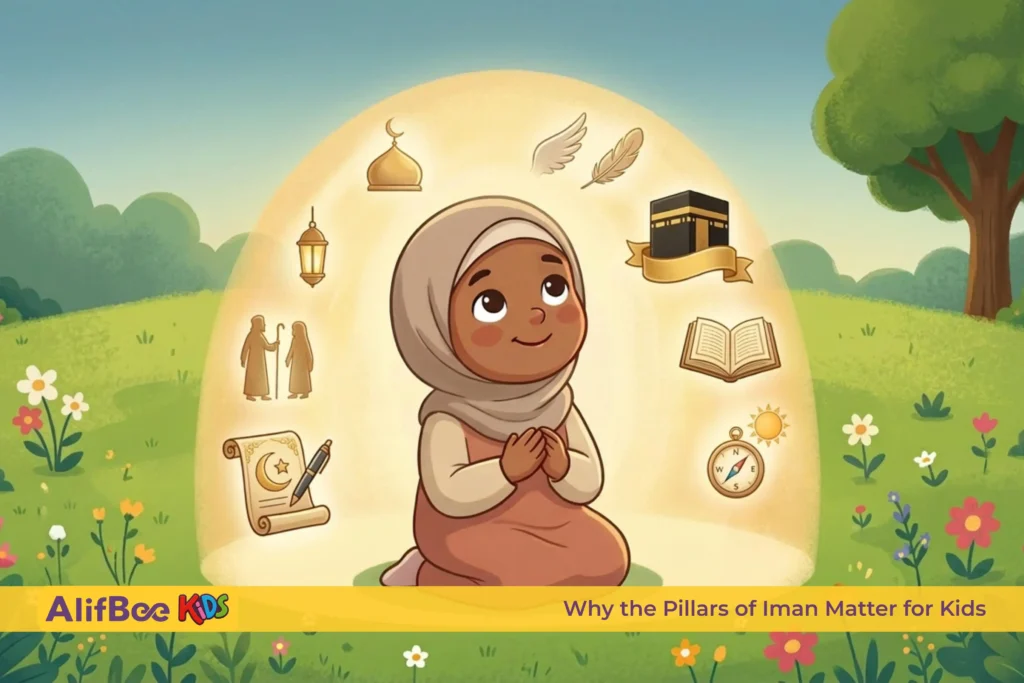
The articles of faith in Islam are not only facts to memorize.
They help children build a strong heart. They give meaning to prayer. They make stories of the prophets more powerful. They teach children that life is not random.
The pillars of iman also help shape character.
A child who believes God sees them may try to be more honest. A child who believes in the Last Day may try to be fairer. A child who believes God is wise may feel calmer during hard times.
That is why learning about faith early is so important. It gives children roots, comfort, and a clear path to follow.
Easy Ways to Teach the Six Pillars of Iman
Use simple examples
Children understand big ideas better when they connect them to daily life.
You can explain belief in angels by talking about things we know are real, even if we cannot see them, like the wind. You can explain divine decree by talking about trying your best and trusting God with the results.
Tell stories
Stories stay in a child’s heart. The stories of the prophets help children see faith in action. They show bravery, patience, and trust in God in ways children can remember.
Repeat the ideas often
Children learn through gentle repetition. Say the six pillars of iman more than once. Ask simple questions. Let them answer in their own words.
Make room for questions
Children ask deep questions. That is a good sign. It means they are thinking. Let them ask who, why, and what. Answer with calm, simple words.
FAQs
They are the six main beliefs in Islam:
belief in Allah, His angels, His books, His messengers, the Last Day, and Divine Decree.
Because faith shapes how a Muslim thinks, lives, worships, and treats others.
Everyone can learn them, and children can start early with simple explanations.
Final Thoughts
The pillars of iman are like lights along the path of faith.
They help children know who God is, understand why prophets were sent, and trust that life has purpose and that every good deed counts.
When kids learn the six pillars of Iman, they are learning more than a list. They are learning how to see the world with faith, hope, and trust. And that is a beautiful place to begin. (Check Five Pillars of Islam for Kids)
You can help your child learn more about Islam and Arabic words with AlifBee Kids. Sign up now and let your child learn more.