How Long Does it Take to Learn Arabic for Kids?
For most kids, learning Arabic is a gradual process. Children usually recognize letters in the early months, begin reading simple words over time, and develop a basic understanding before becoming confident speakers. Progress depends on age, practice frequency, and teaching method.
But during this Arabic language learning journey, how long does it take a kid to learn Arabic? The honest answer is that there is no single fixed timeline. As noted in The Cambridge Handbook of Arabic Linguistics, every child is a unique learner.
In this article, we explore the real learning process and explain how to set realistic expectations for your child’s progress.
What Does “Learning Arabic” Mean for a Child?
For many parents, learning Arabic can mean different things depending on their goals. Sometimes it involves learning Arabic for Quran reading or understanding Islamic values. Others may simply focus on reaching fluency and want to hear their child speaking Arabic right away.
For children, however, learning Arabic happens in small stages. As the brain builds fundamental skills, the learning process becomes much like stacking Lego blocks, where each piece supports the next.
In reality, a child learning Arabic typically progresses through the following stages:
- Mastering the alphabet by recognizing the 28 Arabic letters and their sounds.
- Starting to read simple words and short phrases independently by blending letter sounds.
- Building comprehension by listening to familiar, basic Arabic phrases used in context by other speakers.
- Basic speaking begins with single words and gradually builds the vocabulary needed for everyday interaction.
A child will not become a native speaker overnight, as language proficiency develops in stages. Moving through this process is a natural part of learning Arabic for kids, and understanding this helps parents set realistic expectations while motivating their child.
Average Time It Takes Kids to Learn Arabic (By Stage)
Arabic Alphabet and Letter Sounds
Neuroplasticity in younger children, or their brain’s ability to adapt, allows them to acquire the alphabet and pronunciation more quickly. If language exposure is limited to around two Arabic classes or sessions per week, progress in learning the Arabic alphabet for kids can generally be viewed through the following approximate stages
- The visual recognition stage may take 4–8 weeks for a child to recognize the basic shapes of the 28 letters, based on teaching experience.
- Pronunciation development may take around 3 months to achieve correct articulation, especially for sounds that do not exist in the child’s mother tongue.
- Distinguishing similar letters (such as ح / خ / ج) can require 6–9 months of consistent practice.
Learning the Arabic alphabet can be faster when a child is exposed to it daily through engaging methods such as songs and games. On the other hand, the learning process may take longer if teaching is limited to non-interactive lessons. For more tips on helping your child with sounds and clarity, check out this guide on Arabic pronunciation.
Reading Simple Words and Short Phrases
Once a child learns each Arabic letter in all its forms, they begin to blend sounds. With regular practice, children usually start reading simple Arabic words within 6–12 months. These words are often three to four letters long and part of everyday vocabulary.
As their linguistic knowledge grows, their reading skills naturally expand to include longer and more advanced Arabic vocabulary. This leads to reading simple, familiar sentences, which later develop into richer phrases as overall reading ability strengthens.
Learning to read in a language with a different writing system, such as Arabic, can take longer for children whose first language is English. Because English is read from left to right, children need time to adjust to Arabic’s right-to-left direction. In contrast, children who speak Urdu often find it easier to read Arabic vocabulary, as both languages share a similar writing direction and belong to a closer language group.
Building Vocabulary and Basic Understanding
Building Arabic vocabulary develops in parallel with the reading stage rather than as a separate step. At this phase, learning often relies more on listening, as children tend to remember words they hear and use in their daily lives. Gradually, vocabulary expands as children begin connecting words to familiar themes such as animals, colors, or family members.
Grouping words into shared categories naturally supports this process, especially when combined with tools like educational apps and flashcards that reinforce memory through repetition and visuals. With consistent practice, many children can remember around 10 new words per day, depending on age and teaching method. For deeper insights, see this guide on building a strong Arabic vocabulary
Speaking and Basic Communication
Even when children understand what others are saying, many still struggle to express themselves. Reaching fluency in Arabic takes time. Children often begin by “parroting,” or repeating phrases they’ve heard from Arabic speakers, cartoons, or songs. Over time, they start using these phrases independently and may need a few moments to recall the correct sentence.
In many cases, children may speak with an accent or use incorrect grammar while mixing Arabic with their first language to get their point across. Should you allow this? Absolutely. This is a natural part of the learning process. In fact, it is a healthy sign of developing conversational skills.
For most children, moving from understanding Arabic to speaking it more comfortably often takes 6–12 months of consistent exposure, especially when they interact with the language regularly and meaningfully.
Factors That Affect How Fast a Child Learns Arabic
Child’s Age and Cognitive Development
If you believe that one teaching style or duration works for all children, let me say this clearly: that is not accurate. Children learn differently depending on their age and developmental stage, and each stage requires its own tools—and its own timeline.
Preschool children are like sponges and tend to memorize quickly. They hear a word and repeat it without overanalyzing its meaning. Learning at this age happens through interactive, fun activities such as play and songs, as the brain focuses more on absorption than analysis, leading to progress that may appear faster on the surface.
Younger school-age children, on the other hand, begin to understand why words are used in certain ways. They pay more attention to rules, word order, and sentence meaning. While memorization may be slower, learning is often deeper and more structured, with progress building steadily over time.
Different stages require different tools, and giving each stage enough time helps children learn more effectively.
Learning Frequency and Time Per Week
When it comes to learning Arabic for kids, consistency matters more than long sessions. Children benefit more from short, regular exposure than from a long lesson once a week. Steady routines help language feel familiar and easier to retain.
While there are no fixed rules, 10–15 minutes of daily practice, including light independent study at home, is often effective. If that isn’t possible, 3–4 short sessions per week, combined with guided lessons, can still offer a strong foundation for language development.
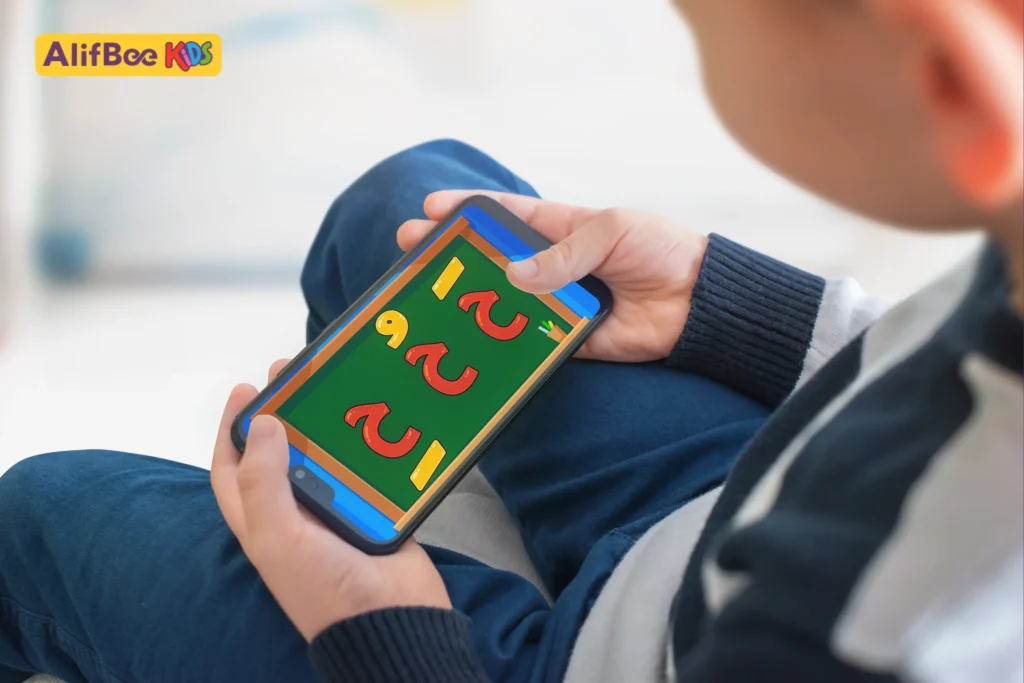
The effectiveness of these sessions depends heavily on the teaching approach. Children progress best through interactive methods, such as using apps or games. Unlike passive lectures or traditional quizzes, which can discourage young learners, these engaging methods ensure that the Arabic language feels natural rather than overwhelming. By choosing this way to learn and tailoring the experience, you make the learning process both fun and effective.
Common Myths Parents Believe About Learning Arabic
Myth 1: “Arabic is so hard—only geniuses can learn it.”
There is a common misconception that Arabic is so complex that only children with a special “language gene” can master it. The truth is that any child can learn Arabic with consistent practice and engaging methods. What matters most is providing an interactive, fun environment …where young learners feel motivated to learn Arabic.
Myth 2: “Kids studying in a course is enough.”
Many parents believe that enrolling their child in a weekly Arabic class is all it takes. However, if language exposure is limited to just one session per week, progress is likely to be very slow. To truly accelerate learning, children need immersion at home as well. Using tools such as Arabic cartoons, songs, or an app for just 10 minutes a day can make a huge difference. Exposure outside the classroom is what turns a student into a learner.
Myth 3: “Children should not speak with an accent; mistakes should be corrected immediately.”
Some parents feel that if a child has an accent or struggles to find a word, they are not “learning correctly.” In reality, speaking with an accent is a perfectly natural part of language development. Expecting instant fluency or immediate correction of mistakes only creates pressure and can discourage children.
Myth 4: “Progress should look the same for every child.”
If you think your child should be at the same level as a peer or sibling, let me be clear: comparing children is not only inaccurate but can also create negative feelings in the learner.
Every child has unique strengths in the learning process, and progress is not a straight line; it is a personal journey. One child may have a “musical ear” and pick up Arabic pronunciation easily, while another may have a more visual learning style and excel at recognizing Arabic letter shapes.
When Can Parents Expect Real Results?
As mentioned earlier, research shows that every child learns differently. For this reason, expecting instant results or rapid fluency is unrealistic. However, reaching an intermediate level in Arabic may typically take around one to two years, depending on the child’s age, exposure, and consistency of practice.
Ultimately, learning Arabic for kids is not a door they simply walk through; it is a staircase they climb step by step. Each stage is a victory. Our role as parents and teachers is to provide support and motivate children to keep moving forward. With consistent practice and care, children can continue making meaningful progress in Arabic.
Conclusion
Learning Arabic is a long journey with ups and downs. Remember, the secret to fast learning success lies in consistent practice and a supportive environment.
If you want a trusted companion on this journey, download the Alfbee App and start today with a free trial. Follow your child’s progress and celebrate every small step.