How do I explain Eid al-Adha to children?
Eid al-Adha for children is one of the most beautiful occasions, leaving a deep impact on their hearts, as it combines joy from new clothes, Eid gifts, and visiting relatives with great religious meanings that should be explained in a way suitable for their ages. However, the real challenge many fathers and mothers face is: how do we explain to a child what Eid al-Adha is? What does sacrifice mean? And why do we celebrate this holiday?
In this article, we offer you a comprehensive guide in a simple and profound style that helps you explain the meaning of the holiday and its values in an educational way, so the child understands and loves this ritual instead of fearing it or seeing it as merely mysterious customs.
What is Eid al-Adha for children?
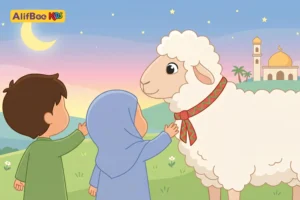
Eid al-Adha is one of the two main holidays for us Muslims: Eid al-Adha and Eid al-Fitr. Eid al-Adha comes after the Hajj season ends, specifically on the tenth day of Dhul-Hijjah. It is a religious occasion linked to a great story of obedience and faith, when God commanded His Prophet Abraham, peace be upon him, to sacrifice his son Ishmael, peace be upon him, and he responded to God’s command. But God ransomed him with a great ram. It can be said that Eid al-Adha is a holiday we celebrate because our master Abraham loved God very much and obeyed Him, so God honored him and made us celebrate this beautiful story every year.
Explaining the etiquette of Eid al-Adha to children
Teaching the child the etiquette of Eid is no less important than explaining its meaning, because it helps him apply values practically in daily life. Among the most important of these etiquette are the following:
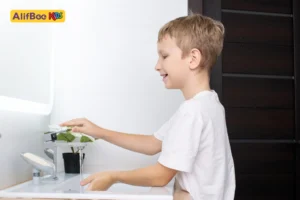
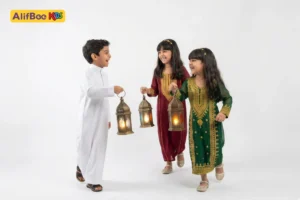
Cleanliness and wearing beautiful clothes: We encourage the child to take a shower and wear his best clothes so he feels the joy of Eid and shares that happiness with others.
- Takbir and joy without harm: The child can be taught to repeat the takbirs in a cheerful way, while emphasizing not to disturb others.
- Maintaining family ties: Visiting relatives and exchanging greetings are among the most important parts of Eid, and they are an opportunity to teach the child the importance of family relationships.
- Helping the poor: One of the most important values to instill is that part of the sacrifice is given to those in need so everyone can feel the joy of Eid.
- Gentleness with animals: The child should be made aware that sacrifice is not cruelty but worship, and that Islam commands mercy toward animals before slaughter.
Why do we sacrifice on Eid?
When explaining the meaning of sacrifice to a child, it is important to simplify the idea without going into complicated details that may confuse him, and instead focus on the human and faith-based meanings close to his understanding. We can simply explain to him that we sacrifice because we love God and want to be like our master Abraham, who obeyed God’s command with all love and trust. From this, the child understands that sacrifice is not merely slaughtering an animal; it is an act of worship carrying deep values such as obeying God, thanking Him for His many blessings, and helping the poor so they can feel the joy of Eid. It also teaches the meaning of giving and sacrificing for others. Educational studies indicate that connecting children to these values through religious occasions greatly helps develop their personalities and build a sense of cooperation and mercy in a natural and balanced way.
At what age should the meaning of sacrifice be explained to children?
There is no single fixed age for explaining the meaning of sacrifice to children, but it is best to consider age stages and each child’s ability to understand. At ages 3 to 6, it is preferable to provide a very simple explanation focused on the atmosphere of Eid, joy, and decorations, while completely avoiding scenes of slaughter so the child does not feel fear.
In the stage from 7 to 10 years old, the story can be explained in more detail, introducing concepts such as obedience and giving in a way that suits their comprehension. When the child reaches 10 years and older, it becomes possible to explain the full story of our master Abraham, peace be upon him, and help him understand the meaning of sacrifice more deeply. He may even be psychologically ready to watch the slaughter process if properly prepared. Therefore, gradual explanation is necessary to ensure the child accepts the idea without fear or shock and to strengthen his understanding of it in a healthy and balanced way.
Introducing Hajj and its rituals to the child
The definition of Hajj for children can be simplified as a big and special journey that Muslims make to Mecca to worship God and perform special rituals that bring them closer to Him. It is the fifth pillar of Islam, and any able Muslim must perform it once in a lifetime. To explain the rituals of Hajj in a way that suits a child’s understanding, they can be described simply and gradually. Ihram means wearing simple white clothes that symbolize equality. Tawaf is circling the Kaaba. Sa’i is walking between Safa and Marwah. Standing at Arafat is the most important day of Hajj, when people pray to God and draw near to Him. Then comes stoning the jamarat, which symbolizes rejecting evil. These concepts can be simplified even more through stories or interactive games, because visual and practical learning helps the child understand more deeply and makes the experience more enjoyable and memorable.
Activities to reinforce the meaning of Eid and sacrifice in children
The best way to instill the concepts of Eid al-Adha and Hajj in a child’s mind is to rely on interactive activities that combine fun and learning, helping him understand the meanings in a practical and realistic way rather than through memorization alone. Among the most notable of these activities are:
- Interactive picture stories: Presenting the story of our master Abraham, peace be upon him, in a simplified style with attractive illustrations helps the child understand the basic idea of sacrifice in an engaging way and strengthens the connection between the story and values such as obedience and faith.
- Handicrafts and artistic creativity: Such as making a sheep model from cotton or paper, drawing the Kaaba and the holy places, or designing Eid greeting cards. These activities develop the child’s imagination and make him interact with the occasion in an enjoyable sensory way.
- Enacting the rituals of Hajj through role-play: The child can symbolically experience the journey at home, such as acting out circling around a simple model or walking between two points to simulate Sa’i; this helps him understand the steps in a practical and easy-to-remember way.
- Participating in distributing the sacrifice: Involving the child in delivering part of the meat to those in need reinforces the value of giving and social solidarity, and makes him feel that he is part of a charitable act rather than just a spectator.
- Cooking and sharing in the kitchen: Preparing Eid meals with the child gives him a sense of belonging to the occasion and strengthens family bonds, making Eid a comprehensive experience that combines joy and learning.
In conclusion
It can be said that Eid al-Adha is not merely a religious occasion that comes every year; rather, it is an integrated educational and human opportunity in which meanings of faith, obedience, and giving are planted in the child in a way that suits his age and awareness. When we understand how to explain the meaning of sacrifice, simplify the story of our master Abraham, peace be upon him, and present Hajj as its beautiful form as a great journey of faith, we build within the child a system of values that will accompany him in his future life, and we do not teach the child information only.
The way we present these concepts is what makes the difference; gradual explanation, stories, practical experience, and calm dialogue are all tools that make the child see religion as a living and beloved meaning rather than just inherited rituals. Hence comes the importance of the role of parents and teachers in transforming this occasion into a warm educational space that combines joy and understanding. The role of the AlifBee Kids app stands out as a modern educational tool that helps instill Arabic language and educational values in children in an interactive and enjoyable way, making learning a natural part of their daily lives and giving them a deeper understanding of their identity and culture from an early age.