At a Glance:
- Eid Al-Adha is a Muslim holiday during the days of Hajj.
- It reminds us of Prophet Ibrahim’s trust in Allah and Allah’s mercy.
- Children can understand it through simple ideas: faith, gratitude, family, prayer, sharing, and helping others.
- It is also a lovely time to practice Arabic words such as Eid, Hajj, Makkah, sadaqah, and Eid mubarak.
Your kids might know that Eid Al-Adha is a happy holiday when they wear new, nice clothes, eat yummy sweets, and enjoy family visits, but it is important to teach them the story behind it, its relation to Hajj, and useful Arabic words related to it.
This blog helps you explain Eid Al-Adha for kids in a simple, warm way. It gives you the story of Prophet Ibrahim for kids, a link to Hajj, Arabic Eid words to practice, and small activities you can try at home.
What is Eid Al-Adha?
Eid Al-Adha is a Muslim holiday that comes during Hajj, the pilgrimage to Makkah. It reminds us of Prophet Ibrahim’s trust in Allah.
You can tell your kids that Eid Al-Adha:
- Is one of the two main holidays for Muslims
- Comes during Hajj, the Muslims’ visit to the House of Allah in Makkah
- Reminds us of the story of Prophet Ibrahim and his son Ismail
- Teaches us to trust in Allah and obey His orders.
- Encourages us to give to the poor and the needy (money, meat, clothes, etc.)
You can start with a simple fact, then add the key details as you narrate the full story.
What does Eid Al-Adha mean?
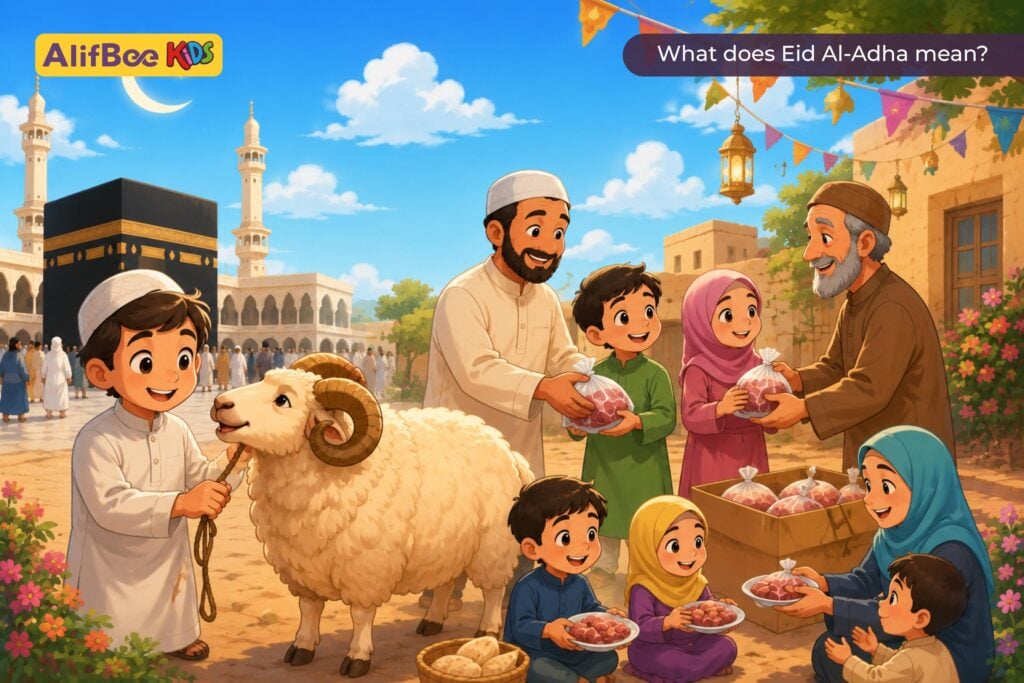
The Arabic name is عِيدُ الأَضْحَى (Eid al-Adha). The word Eid means a celebration or festival, while al-Adha is connected to sacrifice.
The sacrifice associated with this Eid reminds Muslims of the story of Prophet Ibrahim and Prophet Ismail, and their obedience to Allah’s command. Prophet Ibrahim saw in a dream that Allah commanded him to sacrifice his son. When he told Ismail, he replied, “Do as you are commanded. Allah willing, you will find me steadfast.” This story is mentioned in Surah As-Saffat.
Allah then showed His mercy and rewarded them with a ram to be sacrificed instead.
Every year, on Eid al-Adha, Muslims offer a sacrifice called Udhiyah and share the meat with family, neighbors, and those in need.
Why do Muslims celebrate Eid Al-Adha?
Muslims celebrate Eid Al-Adha to remember faith, obedience to Allah, and care for others. It is not only a day of food and new clothes, although children may notice those first.
It is a day that turns big values into things a child can see:
- people praying together
- families visiting or checking on one another
- food is shared with the poor
- many families give charity or meat to people who need support.
Parents can explain Eid to their kids by saying that Eid teaches us to thank Allah and share what we have.
The Story of Prophet Ibrahim for Kids
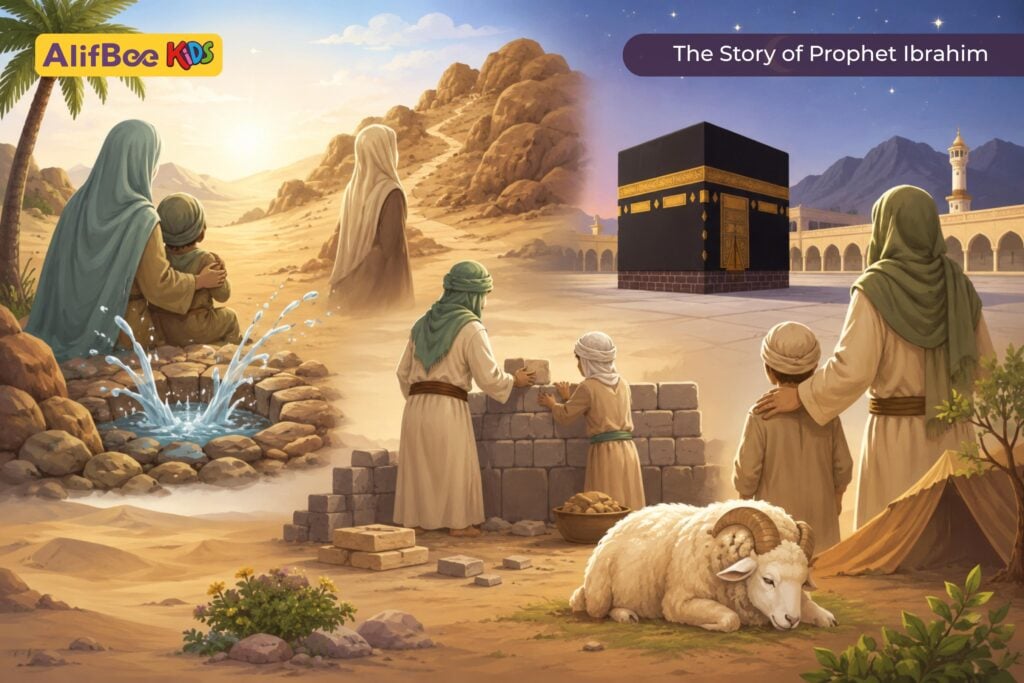
Prophet Ibrahim was a great prophet who loved Allah very much. He always trusted Allah and obeyed Him, even when things were difficult.
Allah tested Prophet Ibrahim many times. One test was when Allah told him to take his wife Hajar and baby Ismail to a quiet desert near Makkah. There was almost no water or food there, but Hajar trusted Allah. She ran between the hills of Safa and Marwah, looking for help. Then Allah blessed them with the water of Zamzam.
Years later, Prophet Ibrahim and his son Ismail built the Kaaba together. They worked side by side and prayed that Allah would accept their good deed.
Allah also tested Prophet Ibrahim with a very difficult command. Prophet Ibrahim saw in a dream that Allah commanded him to sacrifice his son. When he told Ismail, Ismail showed great faith and said that his father should do what Allah had commanded. But Allah, in His mercy, did not let the sacrifice happen. Instead, Allah sent a ram to be sacrificed.
This story teaches us that Prophet Ibrahim, Hajar, and Ismail trusted Allah, obeyed Him, and stayed patient. That is why Muslims remember their story during Hajj and Eid al-Adha.
When told to kids, the Eid Al-Adha story should stay gentle and age-appropriate. You can recite the Surah with your kids where the story is mentioned in Surah As-Saffat 37:102-107.
If your child enjoys stories, you can check other Islamic stories for kids so the story feels part of a wider world of values, not just one isolated lesson.
How Eid Al-Adha connects to Hajj
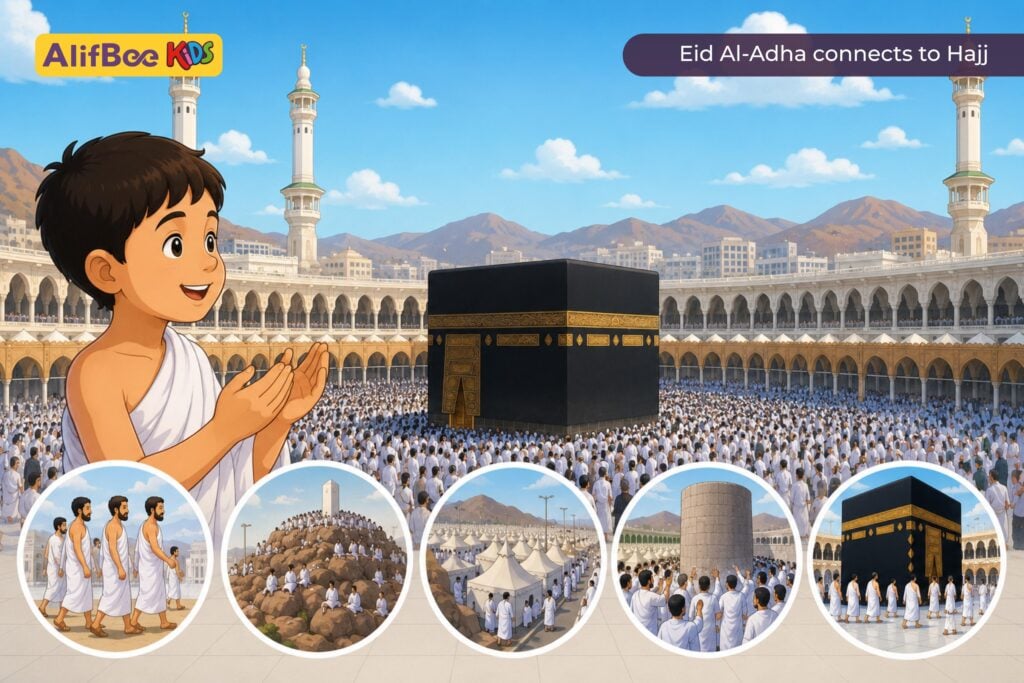
Eid Al-Adha happens during the days of Hajj, which is the pilgrimage to Makkah and one of the Five Pillars of Islam.
You can describe Hajj as a special journey Muslims make to Makkah to worship Allah. Pilgrims wear simple clothes, pray, remember Allah, and visit important places near Makkah. They circle the Ka’ba, perform Sa’y, stand on Mount Arafat, then offer Hady, an animal sacrifice.
These Hajj rituals are tied to the life story of Prophet Ibrahim and the tests he fulfilled to Allah with obedience and patience. From leaving his baby Ismael and wife Hajar in the desert to the test of sacrificing Ismael to Allah to building the Ka’ba with Ismael, each ritual mirrors an act of obedience to Allah. Eid Al-Adha comes as a celebration to all Muslims and a reminder of the reward of patience and obedience.
You can use the story of Prophet Ibrahim and his family to explain each Hajj ritual through a simple, meaningful lesson for children that makes Eid Al-Adha more meaningful.
How to celebrate Eid Al-Adha with Your Kids
Families celebrate Eid Al-Adha in different ways. You can easily include your children in many of the traditions of Eid Al-Adha, such as:
- taking them to Eid prayer in the morning
- buying them nice clothes
- teaching them Eid greetings
- taking them to family gatherings (or making them join you in family video calls)
Some families offer Udhiyah and share the meat with relatives, neighbors, and people in need. If you plan to offer Udhiyah, you can take your children as you go around visiting and distributing the meat with others.
You can also explain to them that not all people can afford to eat meat so this Eid reminds us to give to those in need.
12 Arabic Words Kids Can Learn for Eid Al-Adha
Arabic becomes easier for children when they can use it in real-life situations. The Hajj season and Eid Al-Adha are great times to teach new Arabic words.
| English | Pronunciation | Arabic |
|---|---|---|
|
Eid Al-Adha / Festival of Sacrifice |
Eed al-Ad-ha |
عِيدُ الأَضْحَى |
|
Pilgrimage to Makkah |
Hajj |
حَجّ |
|
Makkah |
Makkah |
مَكَّة |
|
The Kaaba |
al-Ka’bah |
الكَعْبَة |
|
The Islamic month of Hajj |
Dhul-Hijjah |
ذُو الحِجَّة |
|
Prophet Ibrahim |
Ibraheem |
إِبْرَاهِيم |
|
Prophet Ismail |
Isma’eel |
إِسْمَاعِيل |
|
Eid sacrifice / offering |
ud-hiyah |
أُضْحِيَة |
|
Eid prayer |
salat al-Eed |
صَلَاةُ العِيد |
|
Charity |
sadaqah |
صَدَقَة |
|
Saying “Allahu akbar” |
takbeer |
تَكْبِير |
|
Family |
aa’ilah |
عَائِلَة |
Say one word while you point, move, draw, or greet someone.
You do not need to teach the whole table in one day. Pick three words first, especially if your child is younger than 3 years old, then repeat them during the week of Eid. For more Arabic vocabulary to teach your kids during Islamic holidays, check Arabic words for Islamic occasions.
Simple Eid Phrases Children Can Say in Arabic
Start with one greeting your child can actually use. “Eid mubarak” is the easiest first phrase because children hear it often and can say it to grandparents, friends, neighbors, or teachers.
| English | Pronunciation | Arabic |
|---|---|---|
|
Blessed Eid / Happy Eid |
Eed mubarak |
عِيدٌ مُبَارَك |
|
May you be well every year |
kullu aamin wa antum bikhayr |
كُلُّ عَامٍ وَأَنْتُمْ بِخَيْرٍ |
|
May Allah accept from us and from you |
taqabbala Allahu minna wa minkum |
تَقَبَّلَ اللهُ مِنَّا وَمِنْكُمْ |
|
Allah is the greatest |
Allahu akbar |
اللهُ أَكْبَر |
|
Praise be to Allah |
al-hamdu lillah |
الحَمْدُ لِلَّه |
|
Thank you |
shukran |
شُكْرًا |
You can teach your kids to say Eid Mubarak from the age of three. Other general polite phrases, such as Al-hamdulillah and Shukran, are also easy to teach at a young age.
Parents can teach longer Arabic phrases to kids ages 5-7.
How to explain Eid Al-Adha by age
Children do not need the same explanation at every age. I know it is tempting to give the full story at once, especially when the holiday matters to you. But most children understand better when the explanation grows with them.
Younger than 4
Keep it very short. Focus on what they can see and do.
- “Eid is a happy day.”
- “We say Eid mubarak.”
- “We thank Allah.”
- “We share with others.”
Ages 4 to 6
Add the story in one or two gentle lines. Keep the lesson simple: trust Allah and share.
- “Eid Al-Adha reminds us of Prophet Ibrahim.”
- “Prophet Ibrahim trusted Allah.”
- “We celebrate by praying, greeting family, and helping people.”
Ages 7 to 10
You can add more detail about Hajj, Arafah, charity, and the Arabic words connected to the holiday. This age group often asks real questions, and that is a good sign. You can say, “That is a thoughtful question. Let us look at the story together.” You do not have to answer every question perfectly on the spot.
Easy Eid Al-Adha activities that teach Arabic
The best Eid Al-Adha activities for kids do two things: they make Eid joyful, and they help Arabic stick in memory. Try one or two of the following ideas:
- Eid greeting card: Ask your child to write or trace عِيدٌ مُبَارَك on a card. Let them decorate it and give it to someone.
- Arabic word hunt: Place sticky notes around the house: عَائِلَة near a family photo, صَدَقَة near a charity jar, and شُكْرًا on the fridge.
- Story circle: Retell the story of Prophet Ibrahim in three lines, then ask your child: “What did we learn?”
- Matching cards: Match Arabic words to pictures: Kaaba, family, prayer mat, gift, charity box.
- Family charity jar: Let your child place coins in a jar and say صَدَقَة (sadaqah). Keep the focus on helping, not on the amount.
- Hajj map: Show Makkah on a map and say مَكَّة (Makkah). For many children, geography makes the idea more real.
Common Mistakes to Avoid
When you teach children about Eid Al-Adha, the goal is not to give them every detail at once. The goal is to help them understand the meaning of Eid in a gentle, clear, and age-appropriate way.
Here are a few common mistakes to avoid:
1. Giving too much detail too soon
Children do not need a long or complicated explanation of every Hajj ritual or every detail of the sacrifice. Too much information can confuse them, especially if they are still young.
Start with the simple idea: Eid Al-Adha teaches us about love for Allah, trust, obedience, sharing, and helping others.
As your children grow older, you can slowly add more details about Prophet Ibrahim, Hajj, Qurbani/Udhiyah, and the deeper lessons of the story.
2. Making Eid only about clothes and food
New clothes, sweets, gifts, and family visits are beautiful parts of Eid, but they are not the whole story. If children only hear about the fun side of Eid, they may miss its spiritual meaning.
Help them connect Eid joy with gratitude. You can say:
“Allah gave us Eid as a happy day. We celebrate, visit family, eat nice food, and remember to share with people who need help.”
By doing this, you teach them great values and keep the celebration joyful for them as little kids.
3. Skipping the Arabic practice
Eid Al-Adha is a great chance to help children hear and use simple Arabic words in a meaningful context.
Even a few words can make the holiday feel more connected to the Arabic language, so don’t forget to use the Arabic words in this article and check more in the AlifBee Kids app.
Final Word
Eid al-Adha is a great time for family bonding by spending time together with kids, teaching them about the story of Prophet Ibrahim and including them in Eid Al-Adha traditions. It is also a great opportunity to teach related Arabic words through fun Eid activities.
Learn with AlifBee Kids
Want a playful way to practice Eid words, Islamic expressions, and beginner Arabic vocabulary?
AlifBee Kids helps children learn through guided activities, games, stories, and simple practice that feels natural for young learners. You can use the words in this article as a small Eid vocabulary set, then keep building step by step inside the app.
FAQs about Eid Al-Adha for kids
What is Eid Al-Adha for kids?
Eid al-Adha is a Muslim holiday that teaches children about faith, trust in Allah, sharing, and helping others. It comes during Hajj and connects to the story of Prophet Ibrahim.
How do I explain Eid Al-Adha to a child?
Start with one simple idea: Eid Al-Adha reminds Muslims to trust Allah and share with people in need. Add more of the story as your child grows.
What is the story of Eid Al-Adha for kids?
The story teaches that Prophet Ibrahim trusted Allah deeply. Allah rewarded that trust and showed mercy. For children, focus on faith, mercy, and obedience to Allah.
What Arabic words should kids learn for Eid Al-Adha?
Start with عِيدُ الأَضْحَى, حَجّ, مَكَّة, الكَعْبَة, أُضْحِيَة, صَدَقَة, and عِيدٌ مُبَارَك.
How is Eid Al-Adha connected to Hajj?
Eid Al-Adha takes place during the days of Hajj. Hajj is the pilgrimage to Makkah and one of the Five Pillars of Islam.
What activities help children learn about Eid Al-Adha?
Try Eid greeting cards, Arabic matching cards, a simple story circle, a family charity jar, or a map activity that points to Makkah.