At a Glance: Halal means allowed, and haram means not allowed. When explaining these two concepts to kids, parents should use simple food and behavior examples, calm family rules, and gentle reminders that Allah wants what is good, clean, honest, and kind for us.
What Do Halal and Haram Mean?
Halal means something is permitted in Islam. Haram means something is not allowed or prohibited. Parents do not need to begin with complex details. A child-friendly starting point is enough: some things are good and permitted for us, while others are not, and we stay away from them. This simple contrast helps children build understanding without fear or confusion.
Is Halal and Haram Only About Food?
No. Many children first hear these words in connection with food, but the concept is broader than that. Halal and haram also relate to behavior, manners, and choices. Food is one part of this, but the idea also includes the following:
- speech
- behavior
- money
- relationships
- daily choices
A child can understand it simply: halal choices help us do what is good, kind, honest, and pleasing to Allah, while haram choices are things Allah asks us to avoid because they harm us or others.
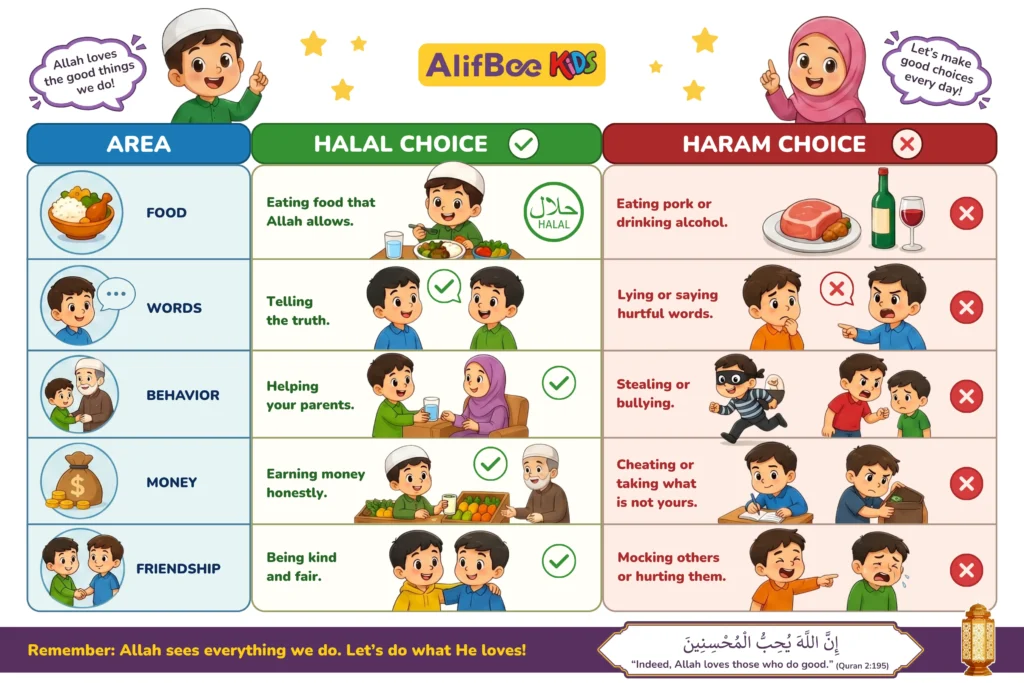
Use the following examples:
| Area | Halal example | Haram example |
|---|---|---|
|
Food |
Eating food Allah allows |
Eating pork or drinking alcohol |
|
Words |
Telling the truth |
Lying or saying hurtful words |
|
Behavior |
Helping parents |
Stealing or bullying |
|
Money |
Earning honestly |
Cheating or taking what is not yours |
|
Friendship |
Being kind and fair |
Mocking others or hurting them |
How to Explain Halal and Haram in Child-Friendly Words
Explain the two concepts in simple and direct words and give examples children can relate to. You might say simple sentences like the following:
- “Halal is what Allah allows because it is good for us. Haram is what Allah tells us to avoid because it is not right for us.”
- “Some food is halal, and some food is not.” “
- Some actions, like telling the truth and being kind, are also part of doing what Allah loves.”
It is important to define these concepts calmly rather than react angrily.
How to Explain Halal and Haram by Age
Children understand rules, responsibility, and intention in different ways, so it’s better to explain halal and haram differently by age.
Under 7: do not explain halal and haram directly
For this age, avoid saying:
- “This is haram.”
- “Allah will be angry.”
- “You are doing something sinful.”
- “Good Muslims don’t do that.”
Instead, use simple language like:
- “We eat this food in our family.”
- “We use kind words.”
- “We do not hurt people.”
- “Allah loves kindness.”
- “Let’s say bismillah.”
- “Let’s share.”
Ages 7 to 10: introduce gently
At this age, you can say:
“Halal means something Allah allows because it is good for us. Haram means something Allah asks us to stay away from because it can harm us or others.”
Ages 10+
Now you can explain more deeply:
“Halal and haram are not only about food. They guide our actions, words, money, friendships, and choices. As Muslims, we learn them slowly so we can choose what pleases Allah.”
You can also introduce “ask when unsure”:
“Some things are clear, and some things need knowledge. If we are not sure whether something is halal or haram, we ask a trusted adult or scholar.”
Easy Halal and Haram Examples Kids Understand
Children learn faster when they can connect a big idea to everyday life. That is why using examples is important. Just remember to:
- Keep the examples simple
- Repeat them often
- Stay close to situations your child already knows, such as meals, snack time, speaking to others, and daily routines.
Food examples
Start with clear, familiar examples.
- Explain simply: Halal food is what Muslims are allowed to eat, and some foods are not allowed.
- Link the idea to goodness: the Qur’an connects lawful food with what is wholesome and good (Qur’an 2:168).
- Give a clear first example: pork is haram.
- Mention briefly: the Qur’an names certain forbidden items clearly (Qur’an 2:173)
- Avoid going into details about ingredients, certifications, or complex cases at this stage.
Behavior examples
Food is only one entry point to the topic. You can also use everyday behavior to help your child understand. You can focus on:
- Saying bismillah before eating
- Telling the truth
- Sharing
- Treating others kindly
All these positive actions help children see that Islam gently guides daily life.
On the other hand, you can also point out examples of what to avoid:
- Lying
- Hurting others
- Speaking rudely
- Taking what is not yours
- Cheating
This keeps the lesson focused on character, not just a list of rules.
How to answer “Why is pork haram?”
We can answer this question in many ways, depending on the age of our child:
Ages under 7: Pork is haram because Allah told us not to eat it.
Ages 7–10: Pork is haram, and we follow this because Allah guides us and we trust Him.
Ages 10+: Pork is haram in Islam, as clearly mentioned in the Qur’an (2:173), and we follow it as part of trusting Allah’s wisdom even when we are still learning the deeper reasons.
How to Teach the Idea Without Fear or Confusion
A calm method works better than a heavy one. Children usually respond well to short explanations, repetition, and clear family habits. You do not need to make everything sound scary to keep the lesson serious.
In fact, mainstream child-development guidance recommends clear limits, calm words, modeling, and positive reinforcement rather than fear-based correction. That matches this topic well: teach the rule, model it, repeat it, and praise your child when they remember.
Use routines and reminders
Try small daily moments instead of one long lecture. At mealtime, say Bismillah together. At the store, point to a product and explain whether it is for your family or not. At bedtime, ask one easy question, such as, “Can you tell me one halal choice you made today?” Children often remember what they hear and do again and again.
Use stories and praise
Stories help values stick. You can pair this topic with Islamic stories for kids or short hadith for kids, so your child sees good choices in a story, not only as a rule. Praise also matters. When your child remembers a phrase, chooses carefully, or speaks honestly, name the good action. Positive reinforcement makes the lesson feel safe and doable.
Common Mistakes Parents Should Avoid
Here are a few common mistakes parents should avoid when introducing halal and haram to children, to keep the message clear, balanced, and age-appropriate.
- Making the topic sound frightening instead of calm and reassuring
- Teaching complex fiqh details before the child is ready
- Overcomplicating the message instead of keeping it simple and clear
- Using “haram” too often for small everyday mistakes
- Not using consistent, real-life examples to support understanding
- Handling unclear or complex issues without trusted scholarly guidance
Final Word
The best explanation is usually the simplest one. When you teach halal and haram with calm words, clear examples, and steady routines, your child can understand the idea without fear. Small lessons repeated with warmth often stay longer than big lectures.
Learn with AlifBee Kids
If you want your child to hear useful Arabic, enjoy values-based stories, and practice through fun guided activities, AlifBee Kids can help. It gives you a playful next step after this lesson, especially when you want Arabic to become part of daily routines instead of a separate subject. You can also extend the topic through practical family activities that turn good manners into lived habits.
FAQs
What do halal and haram mean to kids?
For children, halal means allowed and haram means not allowed. A good first step is to pair each word with one food example and one behavior example so the child understands both meaning and daily use.
At what age should you explain halal and haram to a child?
You can begin with very simple language in the early years. As your child grows, you can add more detail. The key is to match the explanation to your child’s age, routines, and questions.
Is halal and haram only about food?
No. Food is usually the easiest place to start, but the idea also connects to behavior, honesty, manners, and everyday choices. That wider view helps children see that values shape daily life.
How do you explain haram without scaring a child?
Use calm language and short explanations. Focus on safety, goodness, and respect for Allah’s guidance instead of fear-heavy warnings. Children learn better when they feel secure and supported.
What are simple halal and haram examples kids can understand?
Children understand halal and haram more easily through simple daily examples. Halal examples can include saying Bismillah, sharing, and eating halal food, while haram examples can include lying, hurting others, or eating pork.